X I I I
N I T S
C L À S S I Q U E S
D E
L A
T R A M U N T AN A
Concert series with period instruments - 2026 edition
Concert I
March 20th, 7:30 p.m.
Can Gelabert, Binissalem
Ensemble Tramuntana
Violin Duel!
. . . S O O N M O R E . . .
Concert II & III
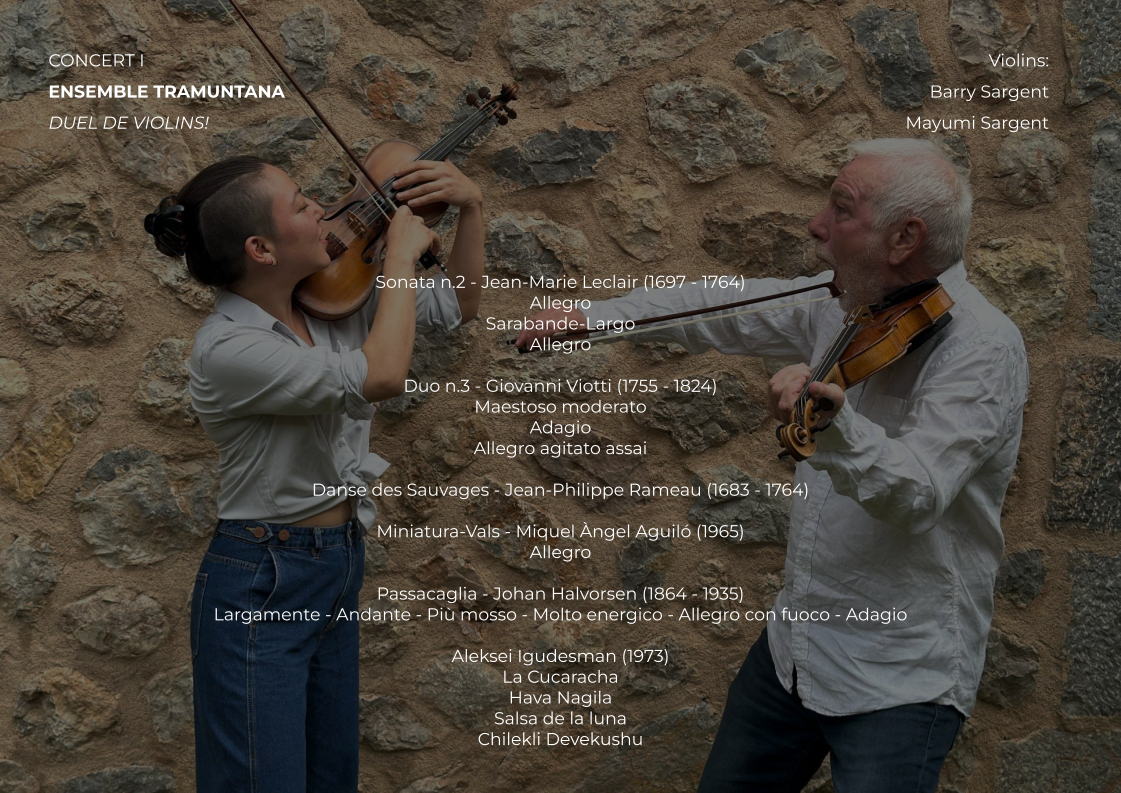
This program offers a fascinating journey from the Baroque to the Classical period, defined by the artistic dialogue between Barry and Mayumi Sargent. Father and daughter meet in a duel of virtuosity that blends the elegant 'battles' of Leclair with the intensity of wild dances and Halvorsen's iconic duo. The repertoire is further enriched by the world musics of Aleksey Igudesman, an invitation to traverse universal emotions—from laughter to nostalgia—reminding us that, despite our differences, we share a common humanity.
April 10th, 8:00 p.m.
Sant Felip Neri church, Palma
April 11th, 8:00 p.m.
Sant Ramón de Penyafort parish, Port of Sóller
Ensemble Tramuntana
Conductor: Barry Sargent
Beethoven's Pastorale
The program reaches its full potential through a contrast of the forces of nature. We open with the Symphony in D minor, 'La Casa del Diavolo', in which Luigi Boccherini immerses us in a universe of rhythmic tensions and an incandescent finale that evokes the descent into hell. It is the perfect prelude—agitated and virtuous—for the evening's main event.
Ludwig van Beethoven's Symphony No. 6, 'Pastoral', stands as the heart of the concert. More than a simple description of landscapes, Beethoven offers us a spiritual experience: 'more an expression of feeling than painting.' From the serenity of the first rays of sunlight to the fury of the storm and the final hymn of gratitude, the 'Pastoral' is a monument to the connection between the human soul and the natural world. A masterpiece that, centuries later, continues to remind us of the peace and strength found in the simplicity of country life.
Concert IV & V
June 12th, 8:30 p.m.
Palma: Sant Felip Neri church
June 13th, 8:30 p.m.
Port of Sóller: Sant Ramon de Penyafort parish
Ensemble Tramuntana
The Soul of the Bass: Bottesini and Dvořák
This program explores the unique sonority of the string quintet with double bass, a formation that transforms the traditional quartet into a small orchestra of deep and vibrant nuances.
We begin with the Grand Quintetto in C minor by Giovanni Bottesini. Known as the "Paganini of the double bass," Bottesini offers a work where the virtuosity of the lowest string instrument blends seamlessly with the lyricism and refinement of Italian opera.
To close, Antonín Dvořák’s String Quintet No. 2 in G major, Op. 77 immerses us in the energy of the Bohemian lands. With the addition of the double bass, Dvořák creates a robust rhythmic foundation that liberates the other strings, infusing every movement with the vitality and nostalgia of Czech folk dances.
Concert VI & VII
June 26th, 8:30 p.m.
Port of Sóller: Sant Ramon de Penyafort parish
June 27th, 10:00 p.m.
Sant Joan Baptista Church, Estellencs
Ensemble Tramuntana
Masters of the sextet: Brahms and Tchaikovsky
This program features two of the most ambitious works in the chamber repertoire, where the doubling of violas and cellos achieves an orchestral-like density and richness of sound.
Johannes Brahms’s String Sextet No. 2 in G major, Op. 36 is a mature masterpiece of ethereal and fascinating beauty. Within its complex counterpoint, Brahms hides a musical farewell to a former love, turning the score into an exercise in nostalgia, mystery, and sonic redemption.
In contrast, Pyotr Ilyich Tchaikovsky’s celebrated "Souvenir de Florence" closes the evening with an explosion of energy. Though conceived under the Tuscan light, this sextet beats with a deeply Russian heart, moving between the lyricism of an Italian serenade and the breathtaking virtuosity of its finale.
Concert VIII & IX
July 17th, 8:30 p.m.
Port of Sóller: Sant Ramon de Penyafort parish
July 18th, 8:00 p.m.
Puigpunyent: Son Puig
Ensemble Tramuntana
Conductor: Barry Sargent
From the Mediterranean Pines to Russian Steppes: Aguiló, Shostakovitch and Tchakovsky
An exceptional sonic journey that connects the luminosity of the Mediterranean with the depth of the Russian tradition through the power of strings. The program opens with a tribute to the centenary of the poet Joan Alcover through Miquel Àngel Aguiló’s evocative Cançó dels pins, a work that translates the identity and landscapes of Mallorca's Tramuntana mountains into music. In stark contrast, Shostakovich’s monumental String Quartet No. 8 (performed in its orchestral arrangement) stands as one of the 20th century's most intense, deeply personal, and gripping masterpieces—a universal cry for freedom. Concluding the evening, Tchaikovsky’s celebrated Serenade for Strings brings pure romanticism and clarity, culminating in the vibrant energy of folk dances from the Russian steppes. This high-octane emotional experience spans from introspective lyricism to exultant celebration.
Concert X & XI
August 20th, 9:00 p.m.
Binissalem: Can Gelabert
August 21st, 8:30 p.m.
Port of Sóller: Sant Ramon de Penyafort parish
Ensemble Tramuntana
Conductor: Barry Sargent
Soloist: Viola de Hoog
CPE Bach and WA Mozart: the Enlightment and the Apotheosis of Classicism
This program explores the evolution of Classicism, from the expressive freedom of the pre-Classical era to monumental symphonic perfection.
The Cello Concerto in A minor by CPE Bach serves as the starting point. The work breaks away from the Baroque through the Style of Sensibility (Empfindsamer Stil), where the cello becomes a deeply human, dramatic, and highly virtuosic voice.
The culmination arrives with the final two symphonies by WA Mozart, composed in the summer of 1788. On one hand, the Symphony No. 40 in G minor presents itself as a tragic and passionate work, steeped in the Sturm und Drang spirit, notable for its melancholy and emotional urgency. On the other hand, the Symphony No. 41 "Jupiter" crowns the concert as the radiant and triumphant apotheosis of Classicism, featuring a final movement that brilliantly merges classical form with a complex five-voice counterpoint.
Concert XII
September 5th, 8:30 p.m.
Sóller: Escolàpies Chapel
Úrsula Pomar and Suzanne Bradbury
Sonic Dialogues
This program proposes a musical journey based on the complicity and exchange of roles between the flute and the piano. Through three masterpieces from different eras, the repertoire explores the capacity of both instruments to converse, evoke images, and fuse their sounds.
The concert begins with the romanticism of Franz Schubert and his variations on Trockne Blumen, a highly virtuosic dialogue full of light and technical demand. It continues with the celebrated Sonata by César Franck, a masterpiece of chamber music that immerses the listener in a passionate, intense, and deeply emotional conversation. Finally, the program closes with Hypnosis by Ian Clarke, a contemporary piece with a dreamlike and magnetic atmosphere that transports the audience into a state of pure sonic suggestion. An essential journey to enjoy the chamber dialogue in its purest essence.
Seminars/Workshops 2026 - 2027
August 22nd
Palma: Ireneu Segarra School
Masterclass 2026
Viola de Hoog (cello)
2026 (t.b.d.)
(t.b.d.)
Lecture and Panel Discussion 2026
Pere Estelrich Does historically informed performance (HIP) have value? Is it an art form in development or in decline?
2027 (t.b.d.)
Palma: Ireneu Segarra School
Masterclass 2027
Andrew Hallock (contralto)
2027 (t.b.d.)
(t.b.d.)
Lecture and Panel Discussion 2027
Carme Fernández The female presence in contemporary musical performance and creation